hankyoreh
Links to other country sites 다른 나라 사이트 링크
1 week into Fukushima dumping, Korea, Japan and US make show of sampling seafood
 Add as preferred source on Google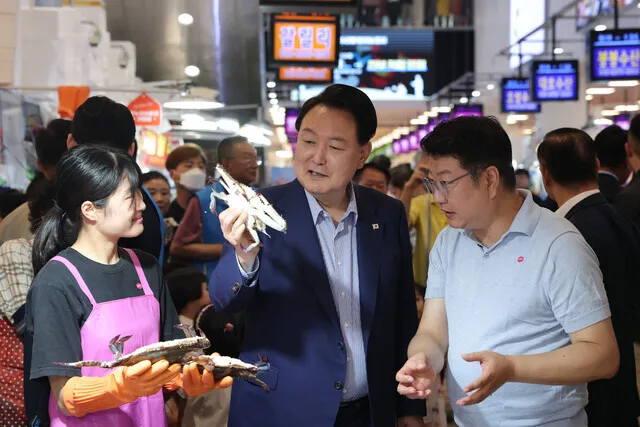
Taking place exactly one week after Japan began dumping contaminated water from the Fukushima Daiichi nuclear power plant into the ocean, the leaders of South Korea and Japan and the US ambassador to Japan drew attention with their coinciding visits to fish markets on Thursday, where they all sampled seafood.
Amid heightened concerns about the safety of seafood following the dumping of radioactively contaminated water, South Korea, the US and Japan are making a show of their concerted response.
President Yoon Suk-yeol of South Korea paid a visit to Noryangjin Fish Market in Seoul on Thursday, where he purchased rockfish, Asian blue crab, and spotted gizzard shad and offered encouragement to fishmongers and others in the seafood industry, according to Lee Do-woon, the presidential spokesperson.
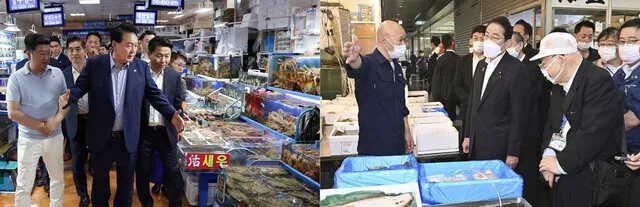
While perusing the stalls on the first floor of the market, the president told sellers that he “hoped to lift the spirits of the merchants by paying a visit.” Yoon dined on rockfish soup at a restaurant at the market with aides including Kim Dae-ki, his chief of staff.
The presidential office underscored that Yoon’s visit was the first trip to the Noryangjin Fish Market by a sitting president in the market’s 96-year history.
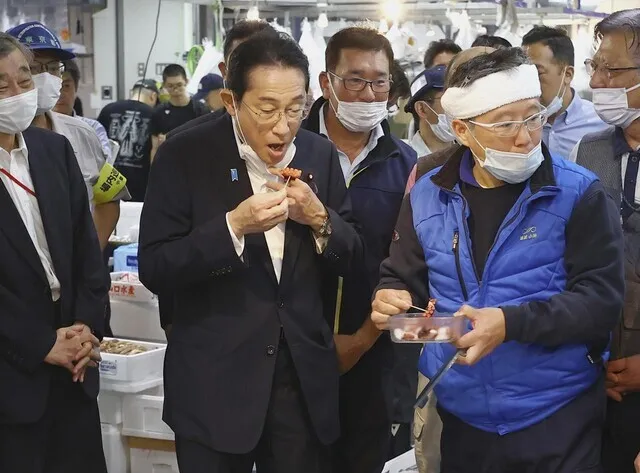
Prime Minister Fumio Kishida of Japan also spent Thursday on an outing to Toyosu Fish Market in Tokyo, where he sampled octopus and cheered on merchants.
This was the prime minister’s second consecutive day of publicly dining on seafood. On Wednesday, Kishida posted on social media about his lunch that day, which had been prepared with seafood from Fukushima.
Writing that Fukushima ingredients and Japanese cuisine are “delectable,” Kishida capped his post on Facebook with hashtags encouraging readers to “send support by eating seafood” and “stop reputational damage from rumors.”
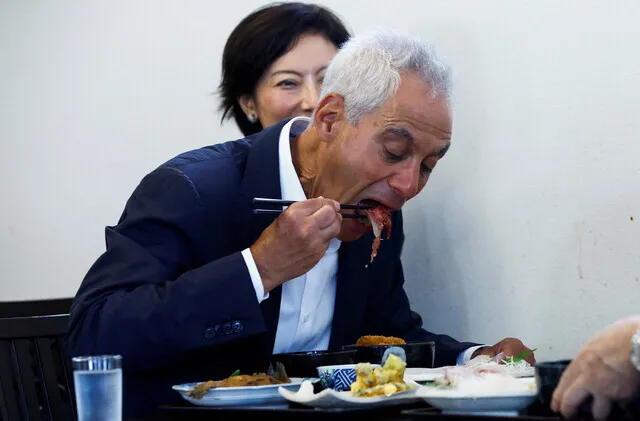
Rahm Emanuel, the US ambassador to Japan, visited the city of Soma in Fukushima Prefecture, where he chowed down on locally sourced seafood on Thursday. Emanuel had previously announced in the local press his intention to visit Fukushima that day.
“The United States stands firmly with Japan, especially when contrasted with China’s overtly political decision to ban all Japanese seafood imports and past failures in openness and scientific cooperation,” the ambassador said in a message posted to the website of the US Embassy in Japan, criticizing China and underscoring Washington-Tokyo cooperation.
By Lee Seung-jun, staff reporter
Please direct questions or comments to [english@hani.co.kr]

Editorial・opinion
![[Editorial] The goal of a nuclear-free Korean Peninsula must not be abandoned](https://flexible.img.hani.co.kr/flexible/normal/500/300/imgdb/original/2026/0824/6017875593453349.jpg "[Editorial] The goal of a nuclear-free Korean Peninsula must not be abandoned") [Editorial] The goal of a nuclear-free Korean Peninsula must not be abandoned
[Editorial] The goal of a nuclear-free Korean Peninsula must not be abandoned![[Column] Is Donald Trump good for the Korean Peninsula?](https://flexible.img.hani.co.kr/flexible/normal/500/300/imgdb/original/2026/0824/7817875606626062.jpg "[Column] Is Donald Trump good for the Korean Peninsula?") [Column] Is Donald Trump good for the Korean Peninsula?
[Column] Is Donald Trump good for the Korean Peninsula?- [Column] The unspoken deal that made China a nation led by engineers
- [Column] Does the US deserve allies’ trust?
- [Column] No, tactical nukes aren’t practical for real-world use
- [Column] ‘The Odyssey’: Finally, a good chamber drama
- [Column] How will the US uphold deterrence when it runs out of weapons?
- [Column] US isn’t pulling out of the Middle East — it’s being kicked out
- [Editorial] Will shift in US nuclear strategy reintroduce tactical nukes to Korea, Japan?
- Why does the USFK commander keep butting heads with Seoul?
Most viewed articles
- 1Seoul sees no imminent deployment of additional North Korean troops to Ukraine
- 2There’s more than meets the eye in Kim Yo-jong’s latest message to Washington
- 3[Editorial] The goal of a nuclear-free Korean Peninsula must not be abandoned
- 4[Column] Is Donald Trump good for the Korean Peninsula?
- 5From cooking to cleaning, humanoid robots put skills to the test in Beijing
- 6[Korea travels] Island escape without the ferry: 3 Incheon islands to explore
- 7[Column] Does the US deserve allies’ trust?
- 8[Column] ‘The Odyssey’: Finally, a good chamber drama
- 9Real-life heroes of “A Taxi Driver” pass away without having reunited
- 10How K-pop broke the internet — and broke into the US market