hankyoreh
Links to other country sites 다른 나라 사이트 링크
In jab at Fukushima dumping, China imposes radiation tests on all seafood imports from Japan
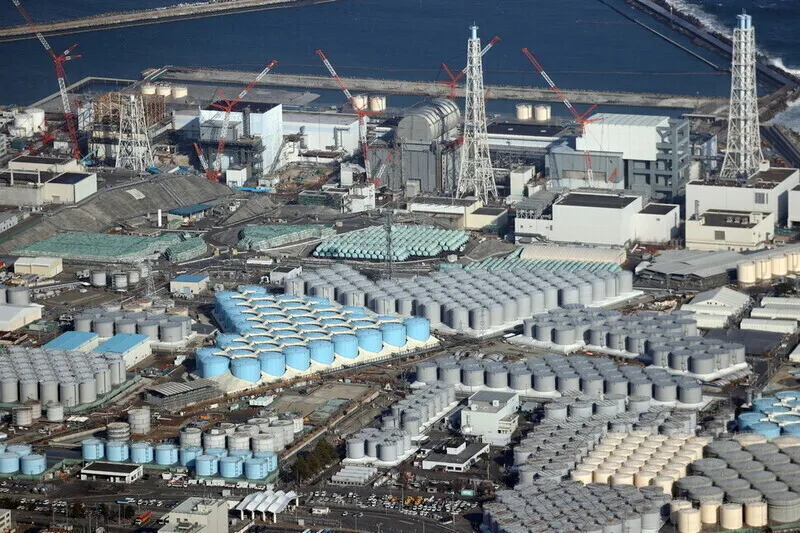
It has been reported that the Chinese government is conducting radiation tests on all Japanese seafood imports during the customs clearance process. This is seen as an attempt to put pressure on the Japanese government, which plans to release contaminated water from the Fukushima Daiichi nuclear power plant into the ocean.
Multiple Chinese and Japanese officials were cited in a report published by Japan’s Tokyo Shimbun on Wednesday that stated that “China’s customs authorities have begun conducting comprehensive radiation inspections on all seafood imports from Japan this month. The Japanese Ministry of Foreign Affairs and the Ministry of Agriculture, Forestry and Fisheries are now in talks about how to respond.”
Previously, in a question-and-answer-style statement uploaded to its website, China’s General Administration of Customs declared its intent to “strengthen controls and rigorously conduct inspections without exception” of Japanese seafood imports. In stark contrast to this, the European Union announced its plans to fully lift import regulations on Japanese agricultural, forestry, and fishery products on July 13. These disparate approaches highlight a global divide in assessing the safety of Japanese seafood.
Following the meltdown at the Fukushima Daiichi nuclear power plant caused by an earthquake in March 2011, which led to the leakage of radioactive materials into the sea, the Chinese government banned imports of seafood from 10 regions of the country, including Fukushima Prefecture. However, for other regions, it only conducted radiation inspections on certain samples. Now, in light of the planned release of irradiated water, China seems to be ramping up its pressure on Japan by shifting to inspections on all seafood imports.
This has inevitably led to a lengthening of the customs procedures for Japanese seafood entering China. Reports indicate it takes approximately two weeks for refrigerated seafood and about a month for frozen products to clear customs. If the inspection process becomes protracted, seafood freshness declines, potentially leading to reduced sales. The owner of a Japanese restaurant in Shanghai told Japan’s Kyodo News that they had “no choice but to use tuna imported from Spain” as seafood imports from Japan came to a halt last week.
Japan’s Ministry of Agriculture, Forestry and Fisheries revealed the value of seafood exported to China in 2022 amounted to roughly 87.1 billion yen (US$625 million). Japanese broadcaster NHK reported, “China is the largest export market for Japanese seafood. There is a concern that the damage could spread.”
On Tuesday, Japanese Prime Minister Fumio Kishida expressed unease at the situation in a statement he made regarding China.
“The International Atomic Energy Agency (IAEA) has concluded that [the release of contaminated water] conforms to international safety standards,” the prime minister said. “We will strongly urge [China] to conduct discussion based on scientific evidence.”
Moreover, Yasutoshi Nishimura, who serves as Japan’s minister of economy, trade and industry, met with reporters on the same day and announced that the Japanese government is working to set up a venue for Japanese and Chinese experts to meet and communicate from a scientific point of view. However, China is reportedly rejecting Japan’s offer.
By Kim So-youn, Tokyo correspondent
Please direct questions or comments to [english@hani.co.kr]

Editorial・opinion
![[Editorial] Korea awaits verdict that will bring Yoon to justice](https://flexible.img.hani.co.kr/flexible/normal/387/232/imgdb/original/2026/0114/2717683786156022.jpg "[Editorial] Korea awaits verdict that will bring Yoon to justice") [Editorial] Korea awaits verdict that will bring Yoon to justice
[Editorial] Korea awaits verdict that will bring Yoon to justice![[Editorial] Starting small will be key for Lee’s big vision for cooperation with North Korea](https://flexible.img.hani.co.kr/flexible/normal/500/300/imgdb/original/2026/0114/1717683780759382.jpg "[Editorial] Starting small will be key for Lee’s big vision for cooperation with North Korea") [Editorial] Starting small will be key for Lee’s big vision for cooperation with North Korea
[Editorial] Starting small will be key for Lee’s big vision for cooperation with North Korea- [Column] Surviving our era beyond the looking glass
- [Column] Welcome to the age of corridors
- [Correspondent’s column] Risks and opportunities in Xi’s gesture to Korea
- [Column] The pretexts of the powerful
- [Column] Why do working-class young people fall for the far right?
- [Editorial] A step in the right direction for South Korea and China
- [Column] Lee’s efforts to write a hopeful new chapter for inter-Korean relations
- [Column] What ‘innovation’ by Coupang’s Kim Bom-suk missed
Most viewed articles
- 1[Interview] Judith Butler: Repressive acts by anti-democratic regimes are ‘confessions’ of fear
- 2‘KPop Demon Hunters’ takes home Golden Globes for animated film, best original song
- 3Korea, China and Japan must find ‘common ground’ and communicate, says Lee
- 4Yoon offers more rationalization, not remorse, in final statement of insurrection trial
- 5Korea, Japan agree to identify remains of those killed in Chosei mine disaster
- 6Special counsel demands death penalty for Yoon in insurrection trial
- 7Why prosecutors are seeking the death penalty for Korea’s former president
- 8[Editorial] Korea awaits verdict that will bring Yoon to justice
- 9Naver unveils HyperCLOVA X in bid to become early leader in Korea’s AI ecosystem
- 10Lee proposes 4 major projects to China, including Seoul-Pyongyang-Beijing high-speed rail