hankyoreh
Links to other country sites 다른 나라 사이트 링크
‘America First’ trade policies likely to hit world in Trump’s first 100 days — experts say Korea needs to prepare for the worst
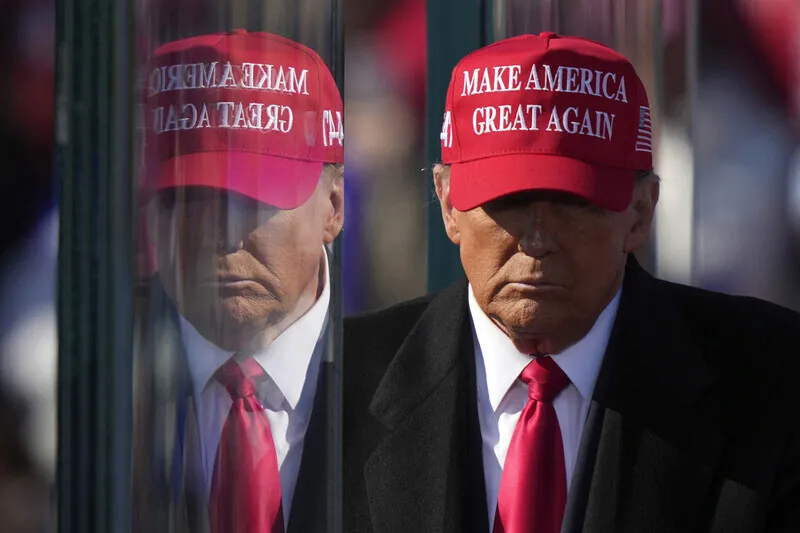
The second Trump administration is expected to quickly initiate economic and trade policies targeting countries with which the US has major trade deficits, such as South Korea, within its first 100 days as part of its motto of “America First.”
With so much on the line — hikes in tariffs, slashing of subsidies, and the precarious fate of the US-Korea Free Trade Agreement — experts say it is imperative that South Korea plans ahead with countermeasures.
This was the analysis of four former ministers for trade — Yeo Han-koo, Yoo Myung-hee, Bark Tae-ho and Kim Jong-hoon — at a roundtable held on Monday at the Federation of Korean Industries head office building in Yeouido, Seoul. The roundtable was titled, “A New US Administration, Is South Korea’s Economy Ready? A Roundtable with Former Ministers for Trade.” Together, the four economists have overseen foreign trade policy under the administrations of Roh Moo-hyun, Lee Myung-bak and Moon Jae-in.
Yeo, the former minister for trade from 2021 to 2022 and current senior fellow at the Peterson Institute for International Economics, relayed the social atmosphere in the US by participating via video call.
“By accomplishing a red wave — as demonstrated by how the Republicans won control of the White House and the Senate — the second Trump administration won’t waste time in pushing for its economy and trade agendas within the first 100 days of its launch,” he predicted.
“Trump 2.0 will pursue its three main goals of reducing trade deficits, revitalizing the US manufacturing industry and securing the upper hand in the US-China hegemonic competition by utilizing trade policy, such as tariffs, as a key tool to pursue its goal of putting America first,” Yeo said.
Yoo, who served as minister for trade during the Moon Jae-in administration (2019-2021) and now is a professor at the Graduate School of International Studies of Seoul National University, said, “As the Trump administration uses trade deficits as a factor to measure the significance of any bilateral relationship, South Korea, which ranks eighth among the countries with which the US has a trade deficit, could be targeted along with China and Mexico.”
Yoo has first-hand experience negotiating with Robert Lighthizer, who in his role as the US trade representative was the architect of protectionist trade policy during the first Trump administration.
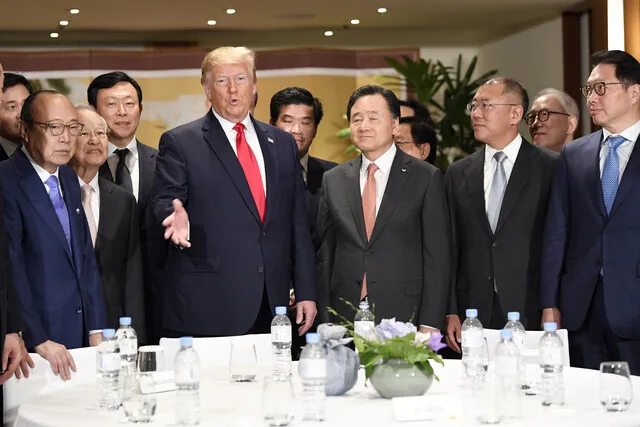
Yoo pointed out that Trump’s first term focused completely on trade deficits as a definitive yardstick — even when it came to its allies — and implemented measures to reduce trade deficits while disregarding World Trade Organization regulations and the US-Korea FTA, as well as taking swift action when negotiations stalled.
“A second Trump term is the biggest obstacle the WTO faces in its 30-year history,” Yoo argued. “If the WTO does not revamp its system, it will enter a new era where the rules-based multilateral trading system is rendered kaput.”
All the former trade ministers were of the opinion that the total abolishment or large-scale revisions to the US-Korea FTA and the repeal of the Inflation Reduction Act and CHIPS and Science Act seemed highly unlikely while also cautioning that South Korea should be prepared for the worst-case scenario.
Former lawmaker Kim Jong-hoon, who served as the chief representative for the US-Korea FTA negotiations in 2006, said, “Since the US has free trade agreements not only with South Korea but with many countries around the world, implementing universal 10%-20% tariffs on all imports and, as such, abolishing or completely revising existing FTAs will not be easy even for the US, considering how US foreign relations and economy will be impacted.”
“However, if negotiations are to happen, it is important to make sure that the interests of both parties are addressed,” Kim added.
Bark Tae-ho, the senior adviser for global trade at the Lee & Ko Global Commerce Institute, who held the position of trade minister during the Lee Myung-bak administration, predicted that sudden changes such as slashing subsidies are “unlikely to happen,” as many regions in the US are Republican districts that benefit greatly from the IRA.
“In the same vein, the CHIPS and Science Act will be largely unaffected, but we may see reductions in grants,” he said.
“If the across-the-board tariffs are imposed on South Korea, we have to be firm when pointing out the clause in the US-Korea FTA that stipulates the elimination of tariffs,” Bark emphasized. “If we respond quickly and effectively to any unilateral measures by the US, we may see our demands, such as exemptions from tariffs, reflected in the final outcome.”
Yeo also commented, “When we think about the situation eight years ago during Trump’s first presidency, South Korean companies have a better name for themselves, as can be seen in their investments in the US. As such, we can flip the crisis around to create new opportunities.”
By Park Jong-o, staff reporter
Please direct questions or comments to [english@hani.co.kr]

Editorial・opinion
![[Column] Japan and South Korea: An alliance of middle powers?](https://flexible.img.hani.co.kr/flexible/normal/500/300/imgdb/original/2026/0615/4017815116945786.jpg "[Column] Japan and South Korea: An alliance of middle powers?") [Column] Japan and South Korea: An alliance of middle powers?
[Column] Japan and South Korea: An alliance of middle powers?![[Editorial] Korea must use G7 summit to band together with fellow middle powers](https://flexible.img.hani.co.kr/flexible/normal/500/300/imgdb/original/2026/0615/5817815111712322.jpg "[Editorial] Korea must use G7 summit to band together with fellow middle powers") [Editorial] Korea must use G7 summit to band together with fellow middle powers
[Editorial] Korea must use G7 summit to band together with fellow middle powers- [Editorial] Sinking Korean youth employment in AI era requires action, and fast
- [Editorial] Korean students show how to protest ballot fiasco without resorting to conspiracies
- [Column] What do people crying election fraud in Korea even want?
- [Column] Once security assets, US bases are now liabilities to host countries
- [Column] Takaichi is putting Japan’s constitution in crisis
- [Editorial] Losing Seoul mayor’s race should be a wakeup call for Democrats
- [Column] Naming the enemy: The unsettling return of ideological litmus tests in Korea
- [Editorial] No excusing ballot shortage fiasco
Most viewed articles
- 1[Editorial] Korean democracy 20 years after the death of Park Jong-cheol
- 2‘Trump surrendered’: US conservatives fume over Iran deal
- 3Goliath’s defeat: What Iran reveals about America’s future
- 4Korea’s conservative opposition leader drags party into battle for election do-over
- 5Seoul’s PPP mayor blasts party leader for exploiting ballot fiasco to cling to power
- 6Korean firms reportedly among backers of $300B Iran postwar investment fund
- 7Samsung to measure how many of its employees’ jobs AI can replace
- 8Korean sports groups denied access to offices for nearly 2 weeks due to ballot protests
- 9With 400,000 undocumented workers in Korea, Lee administration weighs paths to legal status
- 10[Q&A] Why Japan is angling for a military logistics pact with South Korea